
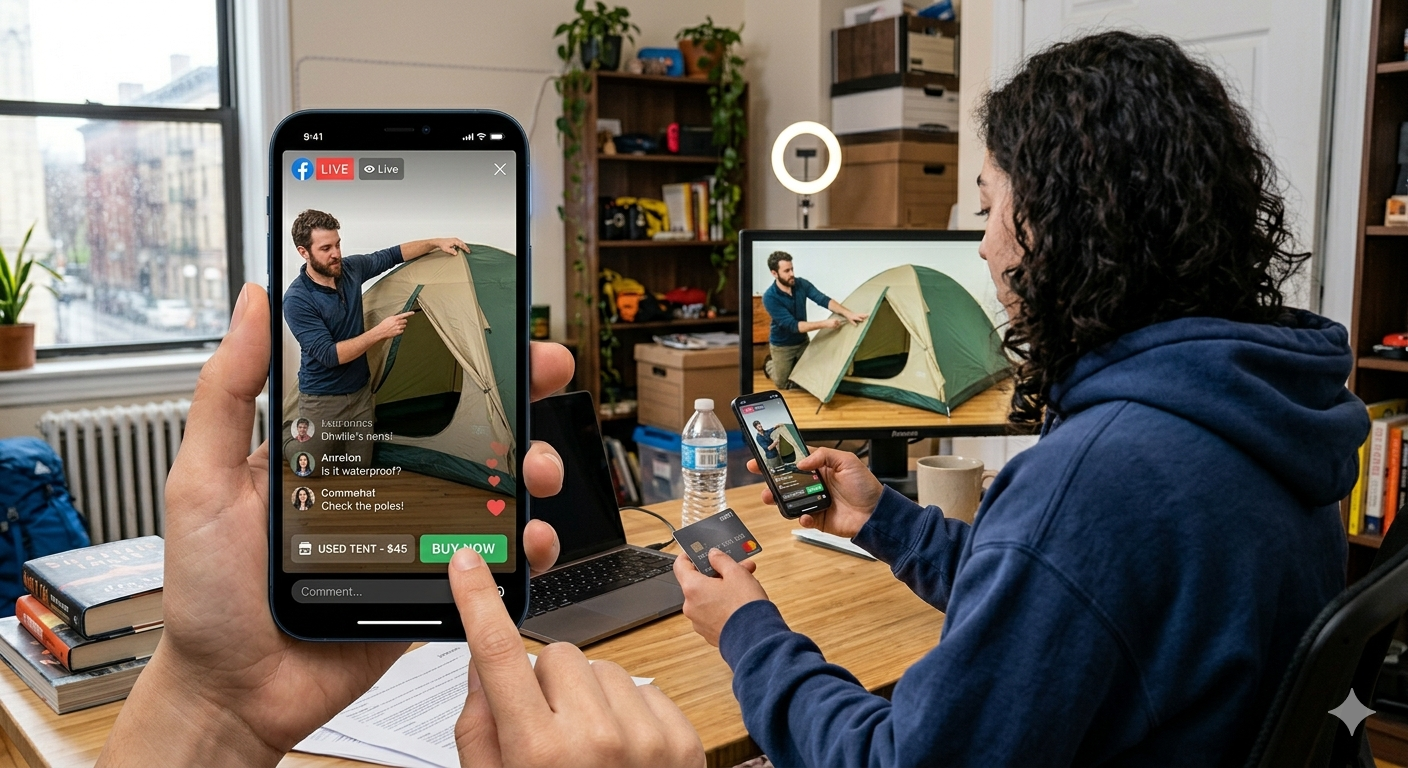
Why buying live can be a better way to judge used gear
Buying used outdoor gear live gives you one advantage that static listings usually do not. You can ask the seller to show the exact parts that decide whether an item is still worth owning. That matters because a used shell, pack, boot, or stove rarely fails in a generic way. It fails in predictable places. If you know where those places are, live buying becomes much less of a gamble.
On TrailTrade, the strongest buying habit is simple. Do not let the overall look of the item make the decision for you. A clean jacket can still have membrane issues. A good-looking pack can still have tired foam or damaged webbing. A boot with plenty of tread can still be on the way to sole separation. Start with the failure points first, then decide whether the rest of the item still makes sense for the price.
If you are browsing live shows or lining up future drops through upcoming streams, go in with a short inspection checklist already in your head. The live format works best when you use it to confirm condition, not just to get swept up by momentum.
Judge wear by function, not by cosmetics
Used gear almost always has some signs of age. That alone is not a problem. The real question is whether the wear is cosmetic, serviceable, or performance-limiting. Buyers get into trouble when they treat all visible wear as equal. It is not.
A few scuffs on a pack lid, slight fading on a shell, or minor marks on a stove case may have almost no impact on use. Cracked coatings, sticky zips, thinning shoulder straps, broken buckle teeth, compressed foam, or failing seam tape are a different story. Those are not character. They are cost, hassle, and risk.
The fastest way to judge value is to ask yourself three questions. First, does the wear affect performance? Second, does it affect comfort or reliability? Third, will fixing it cost enough to erase the deal? If the answer to any of those is yes, the item needs much stronger proof before you bid or buy.
Shells and waterproof apparel
With used waterproof shells, ask for close views of the cuffs, hem, collar, zip garage, and high-friction points under pack straps. Those areas reveal more than the front of the jacket ever will. Look for fabric shine, thinning, peeling, bubbling, or flaking on the inside. If the seller can show the interior clearly, pay attention to seam tape, lining texture, and any sign that the membrane or coating has started to separate.
Also ask how the jacket has been stored and washed. A shell that has been crushed damp in a loft or repeatedly washed badly can look acceptable at first glance but still be on borrowed time. Do not confuse a decent DWR refresh with genuine waterproof integrity. If the seller cannot show the inside cleanly or avoids the question, treat that as useful information.
Packs, straps, and load-bearing points
For backpacks, the important areas are usually the harness, hip belt, back panel, haul loop, compression straps, buckles, and the fabric around attachment points. Ask the seller to pinch the foam in the shoulder straps and hip belt. If it feels flat, dead, or uneven, the pack may already be past the point where it carries weight properly.
Watch for frayed webbing, stretched stitch lines, cracked plastic, and abrasion at the base or corners. A pack can still look tidy from two feet away while telling a harsher story up close. If the frame is removable, ask whether it is complete and whether the seller can show any stay bends, breaks, or improvised fixes.
Footwear and sole condition
Boots and trail shoes deserve a more sceptical eye. Tread depth matters, but it is not the whole picture. Ask to see the midsole sidewall, the rand, the toe area, and the flex point. Compressed midsoles, cracking around the flex zone, failing glue lines, or heel counters that have collapsed usually matter more than surface dirt ever will.
If the seller can twist the shoe slightly on camera, watch how the upper and sole behave together. Separation, odd creasing, or excessive softness can tell you a lot. Insoles also matter. A missing or heavily worn insole may be replaceable, but it can also hint at how hard the rest of the shoe has been driven.
Hardware, metal parts, and safety-adjacent kit
Anything with buckles, poles, valves, clips, or moving hardware should be checked in motion. Ask the seller to open, close, cinch, lock, or deploy the mechanism live. Zips should run cleanly. Buckles should close positively. Pole sections should lock without slipping. Stove controls should turn cleanly if the item category makes live demonstration appropriate.
For climbing or other safety-critical kit, be stricter, not looser. If the item depends on trust in structural integrity, uncertainty is expensive. Wear that might be acceptable on luggage or casual gear can be a hard stop on technical equipment. If the proof feels incomplete, move on. Another item will come.
The questions smart buyers ask on stream
A strong buyer does not ask more questions. They ask better ones. Instead of saying, "What condition is it in?" ask the seller to show the one area most likely to fail. On a shell, ask for cuffs, hem, and inner seam tape. On a pack, ask for the shoulder-strap anchors and base fabric. On footwear, ask for the flex point and heel counter. Specific questions force specific proof.
You should also ask what has been repaired, what has been replaced, and what the seller would flag if they were keeping the item themselves. Good sellers usually answer that without drama. Weak sellers tend to slide back into vague reassurance. The live format helps you hear the difference.
If you are comparing multiple sellers, it is worth spending time on the broader seller directory and the relevant gear categories as well. Better context usually leads to better judgment. You stop asking whether the item looks good and start asking whether it looks good relative to what this type of gear should look like after honest use.
Red flags that should stop you
There are a few patterns that should slow you down immediately. The first is avoidance. If a seller will not show the exact area you asked about, do not invent a reason for them. The second is mismatch. If the verbal description sounds cleaner than the live evidence, trust the evidence. The third is pressure. If the item only works as a purchase because you stop looking closely, it is not a strong buy.
You should also step back when condition details are technically visible but practically useless. Dim lighting, shaky camera movement, quick pans, or vague close-ups are not proof. They are a substitute for proof. If the live inspection is not clear enough for a real decision, wait for a better item.
For platform questions, checkout flow, or basic buying mechanics, the help centre can answer the process side. But condition judgment is still on you. The whole point of live buying is to improve your odds with better proof, not to outsource common sense.
A simple TrailTrade buying routine that works
Before the show, decide what condition level you are willing to accept. During the show, ask for proof on the failure points first. Before checkout, sanity-check whether the wear changes performance, comfort, reliability, or resale. That routine sounds basic, but it filters out a surprising number of bad buys.
The buyers who do well on TrailTrade are not necessarily the fastest. They are the most disciplined. They know that a bargain only exists if the remaining life of the item still justifies the spend. Live video gives you better evidence. It does not remove the need to judge that evidence properly.
If you use the platform that way, you will make fewer emotional buys and more durable ones. That is the real upside of buying used outdoor gear live. Not excitement for its own sake, but better proof, better judgment, and a higher chance that the gear arriving at your door is exactly what you thought you were buying.
FAQ
Common questions
What should I check first when buying used outdoor gear live?
Start with the areas that fail under real use, such as fabric wear, zips, buckles, straps, foam collapse, sole condition, and any signs of repairs or delamination.
Is live buying better than buying from static listing photos?
It can be, because you can ask for close-ups, see how the item moves in hand, and get proof on the exact parts that matter instead of relying on a few selected stills.
When should I walk away from a used gear purchase?
Walk away if the seller avoids basic condition questions, cannot show critical wear points clearly, or if the item shows damage that affects safety, waterproof performance, support, or long-term usability.
Does cosmetic wear always mean bad value?
No. Honest cosmetic wear can be fine if the fabric, hardware, support, and core performance are still strong. The key is separating normal use from structural decline.
Keep reading
Related articles
Seller stories
What a Strong First Seller Launch Looks Like on TrailTrade
A strong first seller launch earns trust before the room goes live with cleaner inventory, clearer proof, and a better buying path.
Read article
Field notes
Why Replay Matters More Than the Live Moment in Gear
Replay keeps TrailTrade gear shows working after the live room ends, giving buyers more time to inspect, compare, and buy with confidence.
Read article
Live selling tactics
How to Set Up Your First TrailTrade Stream Without Chaos
A practical seller guide to getting your TrailTrade account, lots, pricing, stream structure, and first live room ready without making the setup messy.
Read article